


Shoes On or Off
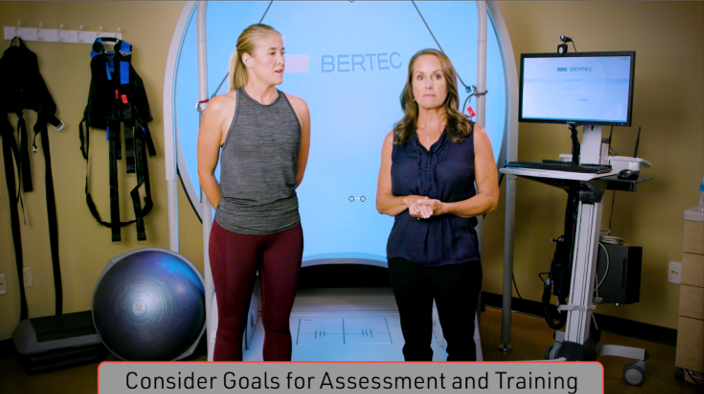
Many new users of CDP have inquired about whether to assess a patient with shoes off or on, and the answer to that decision is that it is up to you, but you should consider your goals for assessment and training.
It is important to note that the normative data in the system is collected with shoes off. However, as a clinician, you should always keep your patient’s goals and functional status in mind. For example, if you have a patient that will always be wearing orthotics and their goal is to improve their balance when out in the community, then testing them with shoes on would be more appropriate because that will be their typical state.
If instead, your patient’s goal is to improve getting up in the middle of the night without shoes on, then consider measuring with shoes off. Another benefit to assessing them without shoes is that it is easier to place their feet properly, which we will go into next.
The most important thing about the shoes on or off debate is whatever you choose, you must maintain consistency. So if you assess them shoes off, make a note of it and ensure that their shoes are off for all subsequent sessions.
Foot Placement
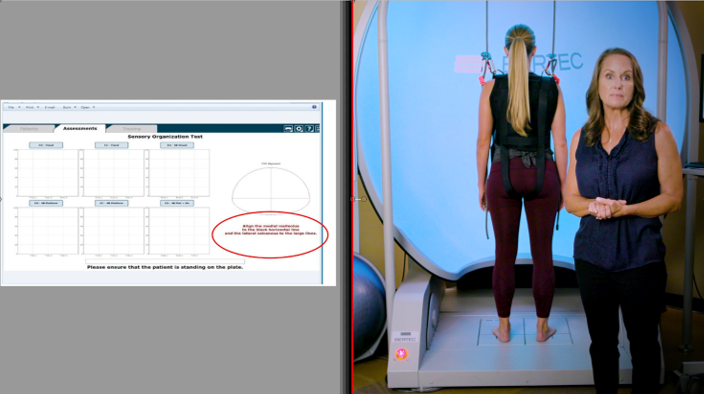
Once the patient is safely secured, you will need to properly place their feet on the markers on the floor of the system, the CDP will display instructions for you on how to do this each time. The first thing that I always do is determine which of the three vertical lines on the force plate to use based on my patient’s height. The system will tell you which block vertical line to use and will be displayed on the screen stating either the small, medium, or large line based on their height.
I ask the patient to hold onto the bars just to keep their balance. Now if your patient is tall, their foot is going to be aligned to the large vertical line. Then, I actually pick the foot up and I place it exactly where I want it to go. I align the lateral calcaneus, which is the outer part of the heel along the black vertical line, the large one, and then I align the medium malleolus, which is this inner ankle bone, along the black horizontal line. So at that point, their right foot is exactly where I want it to be. And I use my fingers to make sure I have their foot aligned exactly where I want it. And then I do the same thing with the left foot.
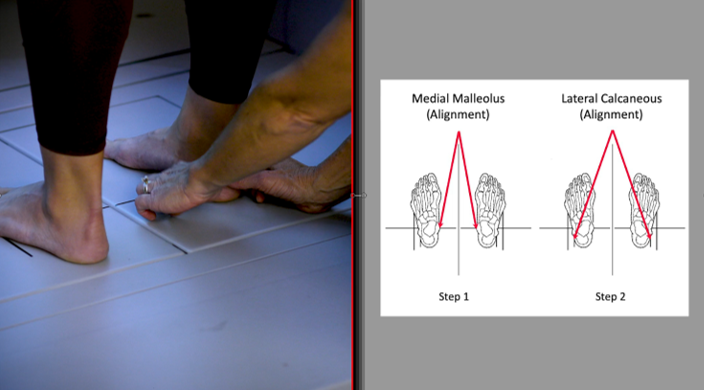
It’s very important to make sure you obtain an accurate measurement of the center of gravity of alignment when performing your assessments. So accurate scoring of these assessments requires that the feet are centered appropriately on each of the left and right sides of the force plate. The amount of distance between the feet is calculated depending on both the patient’s height and the predictions of our limits of stability as we discussed in the Foundations 101 course. The results of your assessments can be negatively affected if you do not place the feet appropriately prior to testing. It’s important to note that not all assessments require this strict foot placement, and we’ll go over this as we review each one in detail. However, in my opinion, it is always good to be in the habit of correct foot placement at all times to maintain consistency between assessments and reassessments.
So once you have their feet aligned appropriately, you can now allow your patient to stand in a more relaxed fashion based on their normal stance position. And we call this allowing your patient to splay their feet.
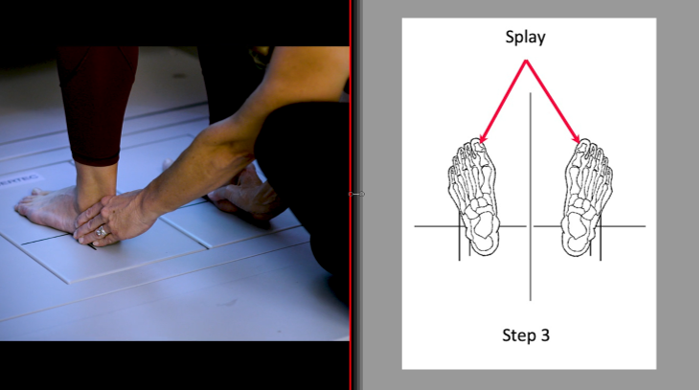
You may find that some of your patients are more comfortable with their toes going in a little bit. You can have them move their toes in slightly and get in a comfortable position. And that is the position that you can do all of the testing for the splay. However, most of the assessments allow for your patients to splay their feet to stand more comfortably, but there are a few that do not allow for this. The weight bearing squat is one assessment that asks you to have your patient keeping their toes pointed forward and not to splay their feet. This is also the case for the single leg stance assessment, where the foot remains in a straight or a neutral position when testing.
About the Author
Shelly Massingale is Service Line Administrative Director of Banner Sports Medicine. She graduated from Pepperdine University in 1992 and from University of Southern California in 1996 with a Masters Degree in Physical Therapy. Shelly has been treating clients with vestibular and balance disorders for the past 18 years and is a certified and advanced certified vestibular therapist through Emory University. She has been working with clients and athletes with concussions her entire career.


