


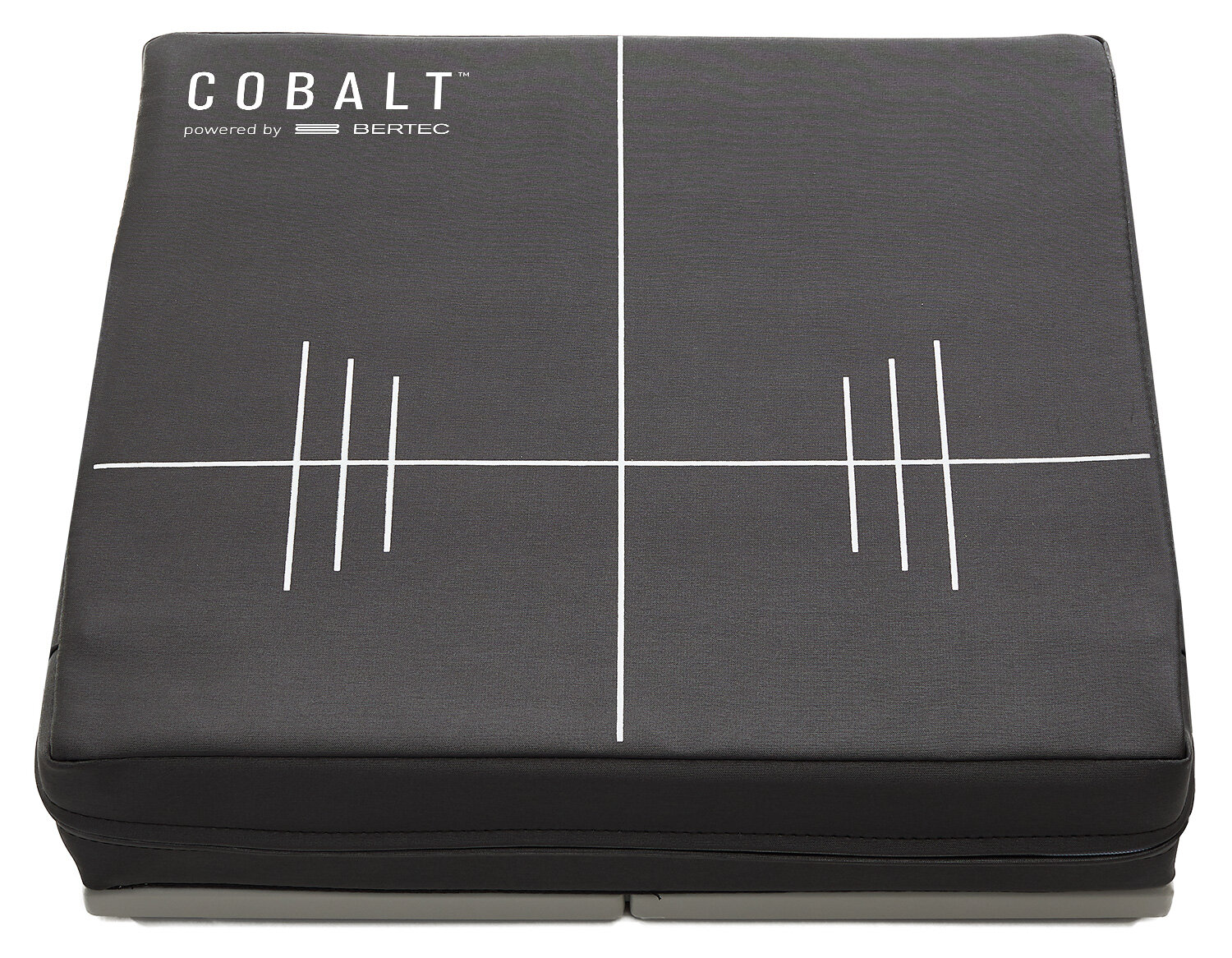
COBALT is a balance test for athletes. COBALT can be used as part of a concussion screening and management program by providing an objective measure of balance control when relying on visual, somatosensory and vestibular demands.
The patented COBALT protocol includes a unique set of testing conditions that places high demands on the visual and vestibular systems that traditional static balance testing does not provide. To better assess balance in athletes, studies have shown that adding higher demand visual and vestibular cues can identify balance impairments that may otherwise not be found with more traditional static balance testing.
There are eight conditions in COBALT, and 4 of them are taken from the Modified CTSIB. Why? The mCTSIB conditions are stable balance measures, and these are used as a method of comparison with additional dynamic measures in COBALT that place a higher demand on the visual and vestibular systems.
Functional Significance:
-
The demands an athlete faces in their sport, such as running with tracking a moving object, spinning, quick turns, etc. require a higher function of balance.
-
Impairments in the VOR can affect athletic performance, result in movement-related symptoms, and potentially increase the risk for injury.
-
Concussion has shown to impair balance. Research studies utilizing COBALT have shown a significant decline in balance post-injury compared to baseline scores, as well as an increased number of errors while performing the test. COBALT cannot be used to diagnose a concussion.
-
COBALT adds to standard static balance assessments by adding the head-shake with eyes closed (which places a higher demand on the vestibular system), and the VOR Cancellation (or Motion Sensitivity Test), that places a greater demand on the visual system.
Measures of COBALT:
-
Each of the twenty second trials are scored by counting errors or loss of balance by the subject. Quantifiable errors/loss of balance consists of the following:
-
Lifting hands off iliac crest
-
Opening eyes during eyes closed trials
-
Stepping off force plate or moving feet from placement markers while on plate/foam
-
Unable to keep beat with the metronome for 2 beats in a row or greater
-
Note: If subject commits multiple errors simultaneously, only one error is recorded
-
-
After the clinician counts an error, she/he should simply resume the assessment, continuing to count errors until all 8 trials are complete.
Conditions of COBALT:
Each condition is performed twice, and each trial is 20 seconds.
A metronome is used to help maintain the rhythm of the patient’s head movement during the dynamic conditions of COBALT. The pace of the metronome is set at 120 bpm when the head is moving with eyes closed, and 40 bpm for the motion sensitivity test.
-
Condition 1*: Eyes open firm surface
-
Condition 2*: Eyes closed firm surface
-
Condition 3: Eyes closed firm surface head shake
-
Condition 4: VOR cancellation firm surface
-
Condition 5*: Eyes open foam surface
-
Condition 6*: Eyes closed foam surface
-
Condition 7: Eyes closed foam surface head shake
-
Condition 8: VOR cancellation foam surface
*C1,C2, C5, C6 = Conditions of the mCTSIB assessment
Key Considerations of COBALT: Which patient populations are appropriate for COBALT?
COBALT is not only a great tool for post-injury assessment and rehabilitation over time for athletes, it is also excellent as an injury prevention screening. The 8 conditions of COBALT can be distilled into only 2 conditions (7 & 8 of COBALT) as a screening assessment, making it easy and accessible to perform on sports teams, and for active populations.


